


AI & FUTURE OF SCREENING | EDITORIAL
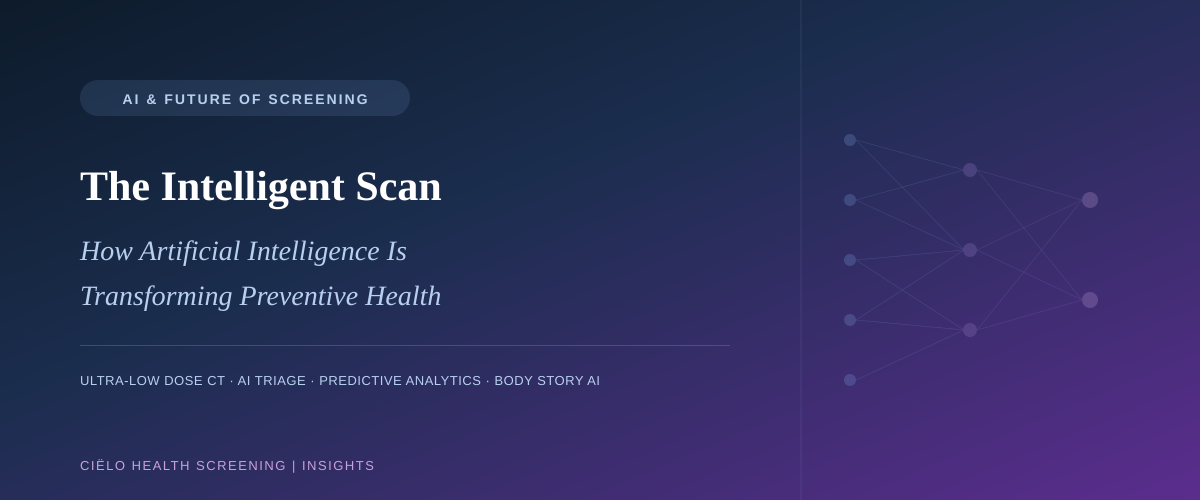
The Intelligent Scan
How Artificial Intelligence Is Transforming Preventive Health
For most of the history of medicine, diagnosis has depended on the human eye—trained, experienced, but ultimately limited by the constraints of attention, fatigue, and the sheer volume of data that modern imaging produces. A single CT scan of the chest generates hundreds of images. A whole-body MRI produces thousands. Within each image, there may be findings that are obvious and findings that are subtle—patterns that emerge only when viewed in the context of other data points, other images, other biomarkers.
Artificial intelligence does not replace the physician’s eye. It augments it. It processes what the human brain cannot hold simultaneously. It detects patterns across datasets that would take a clinician hours to review. And in the context of preventive health screening—where the mandate is to find early, often subtle abnormalities in otherwise healthy individuals—this augmentation is not a luxury. It is becoming a clinical necessity.
What AI Actually Does in Screening
The popular imagination tends to oscillate between two poles when it comes to AI in healthcare: uncritical enthusiasm or reflexive scepticism. The reality is more measured and more interesting. In the context of preventive screening, AI serves several specific, well-defined functions that measurably improve the quality of care.
Pattern Recognition at Scale
AI algorithms trained on millions of medical images can identify patterns with a consistency that exceeds human capability in specific tasks. In lung screening, AI-assisted CT interpretation has been shown to detect pulmonary nodules—potential early-stage cancers—with sensitivity equal to or exceeding that of experienced radiologists. In mammography, AI systems have demonstrated the ability to flag suspicious lesions that might be missed in the fatigue of high-volume reading sessions.
This is not about replacing radiologists. It is about providing them with a second pair of eyes that never tires, never loses concentration, and can flag the subtle asymmetry or faint density change that might otherwise be overlooked in a busy clinical day.
Risk Stratification and Triage
In a screening programme that processes hundreds of patients, not every scan requires the same level of scrutiny. AI systems can triage incoming data—identifying scans that contain potential findings requiring urgent review and separating them from scans that appear unremarkable. This allows radiologists to allocate their expertise where it is most needed, improving both efficiency and diagnostic yield.
At a more granular level, AI can assign risk scores to specific findings. A pulmonary nodule’s size, shape, density, and growth rate (if prior imaging is available) can be algorithmically assessed to determine its likelihood of malignancy. A coronary calcium distribution pattern can be analysed to refine cardiovascular risk beyond what the aggregate score alone conveys.
Quantitative Measurement
One of AI’s most valuable contributions to screening is precision quantification. Liver fat fraction, visceral-to-subcutaneous fat ratios, bone mineral density trends, cardiac chamber dimensions, and vascular calcification burden can all be measured with a reproducibility that manual measurement struggles to match. This consistency is critical for longitudinal tracking—comparing a patient’s results over successive screenings to detect subtle changes that might indicate early disease progression.
Ultra-Low Dose CT: The Enabler
The integration of AI with imaging is particularly transformative in the context of ultra-low dose computed tomography. Traditional CT scanning, while diagnostically powerful, carried radiation exposure levels that limited its suitability for screening asymptomatic populations. The development of ultra-low dose protocols—reducing radiation by up to 97 per cent compared to standard diagnostic CT, to levels comparable to a chest X-ray—has fundamentally changed the equation.
AI plays a direct role in making this possible. Lower radiation doses produce noisier images. AI-based noise reduction and image reconstruction algorithms restore diagnostic quality without increasing dose. The result is a scan that delivers the structural information of CT—lung nodules, coronary calcification, visceral fat, skeletal integrity, abdominal organ assessment—at a radiation exposure that is safe for annual screening.
This combination of ultra-low dose technology and AI-enhanced image quality has opened the door to population-scale screening that was previously impractical. It is one of the most significant advances in preventive imaging in the past two decades.
From Reactive Reporting to Predictive Intelligence
The current generation of AI in screening is largely diagnostic—it identifies and quantifies what is present in a scan today. The next generation will be predictive. Algorithms trained on longitudinal data—years of sequential scans, blood results, lifestyle data, and outcomes—will move from asking “what is there?” to asking “what is likely to develop?”
Imagine a screening report that not only documents a coronary calcium score of 80 but also models, based on the patient’s metabolic profile, genetic markers, and lifestyle factors, the likely trajectory of that score over the next five years under different intervention scenarios. Or a liver assessment that not only quantifies current fat fraction but projects the probability of progression to fibrosis based on inflammatory marker trends and insulin resistance patterns.
This is the vision of predictive health intelligence—a system that synthesises all available data into a forward-looking model of an individual’s health. It does not predict the future with certainty. But it narrows the uncertainty enough to guide meaningful, personalised intervention.
The Body Story: Towards Integrated Health Narratives
The logical endpoint of AI integration in screening is what might be called the Body Story—a comprehensive, AI-generated health narrative that synthesises imaging, blood work, functional data, genetic markers, and lifestyle context into a single, coherent account of a person’s health. Not a collection of reports from different departments, but a unified story told from the perspective of the body itself.
Such a system would identify not only individual findings but the connections between them. It would flag the convergence of rising HbA1c, increasing liver fat, declining bone density, and early vascular calcification as a metabolic syndrome trajectory. It would note that a patient’s pharmacogenomic profile suggests they are a poor metaboliser of a commonly prescribed statin, recommending an alternative. It would track trends over years, highlighting improvements and areas of concern with equal clarity.
This is not science fiction. The individual components of this system already exist. What remains is the integration—the architectural work of bringing these data streams together into a platform that is clinically rigorous, patient-friendly, and continuously learning.
The Human Element
The most important truth about AI in screening is that it enhances human judgment; it does not replace it. Every AI-generated finding requires clinical interpretation. Every risk score requires contextualisation against the patient’s history, values, and preferences. The conversation between doctor and patient—the moment when data becomes understanding—remains irreducibly human.
AI excels at processing volume, maintaining consistency, and detecting patterns. Humans excel at integrating context, exercising judgment, and communicating with empathy. The best screening programmes of the future will be those that leverage both—using AI to ensure that nothing is missed and clinicians to ensure that everything is understood.
India’s Opportunity
India is uniquely positioned to lead the global integration of AI into preventive health. The scale of its population provides the data diversity that AI systems need to train effectively. The cost discipline of its healthcare ecosystem forces innovation toward efficiency. The growing digital infrastructure—from Aadhaar to UPI to the National Digital Health Mission—provides the connectivity backbone that AI-enabled screening requires.
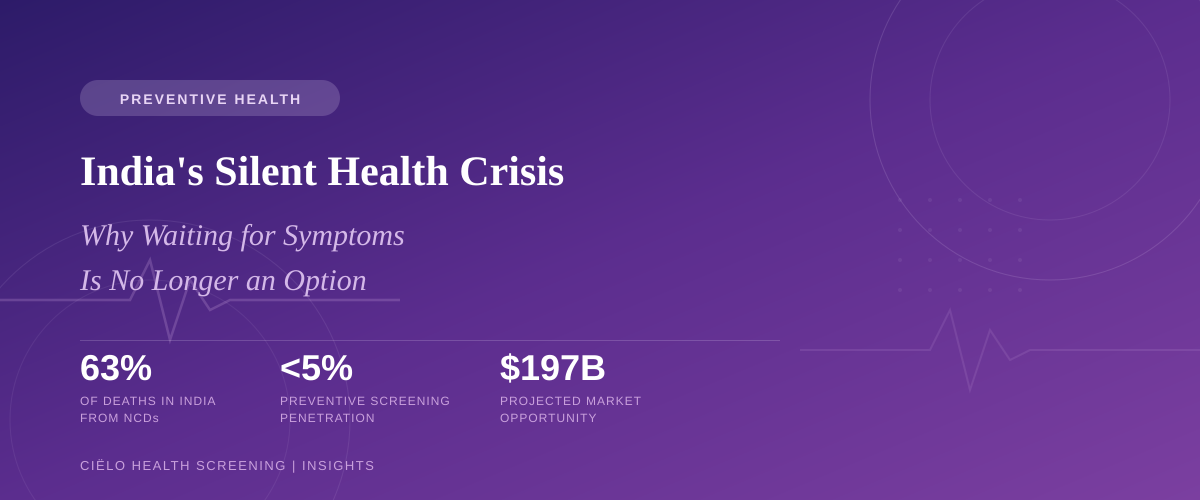
More fundamentally, India’s need is urgent. With fewer than five per cent of the population accessing structured preventive screening, and with lifestyle disorders rising at rates that threaten to overwhelm the curative system, AI-enabled screening is not merely desirable. It is essential to scaling prevention to meet the magnitude of the challenge.
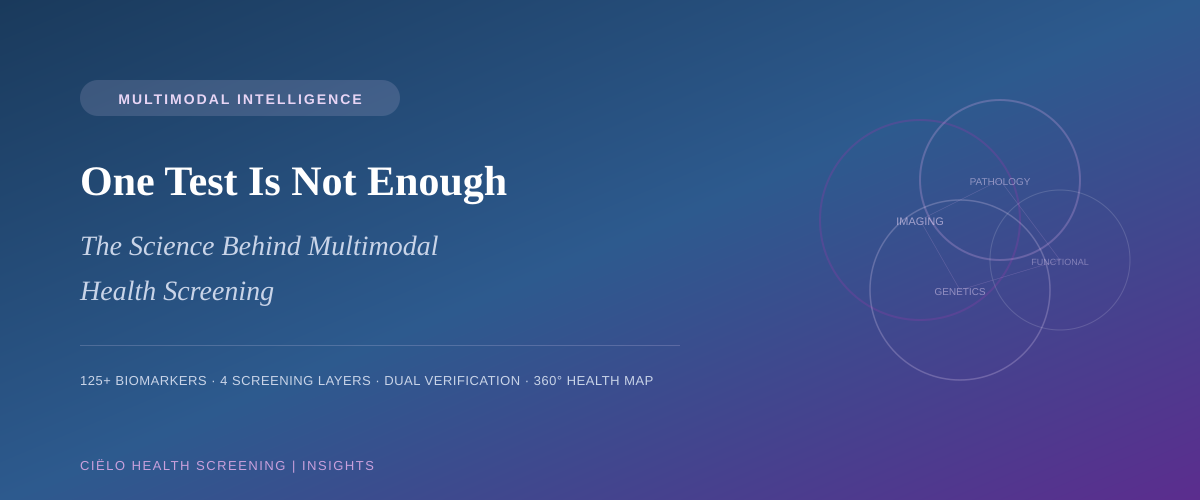
The future of preventive health will not be defined by any single technology. It will be defined by the intelligence with which multiple technologies—imaging, pathology, genetics, functional testing, artificial intelligence—are orchestrated into a seamless, patient-centred experience that makes early detection not just possible but routine.
AI does not replace the physician’s eye. It augments it—processing what the human brain cannot hold simultaneously, detecting patterns that emerge only when the whole picture is visible.
About Ciëlo Health Screening Ciëlo integrates AI-powered imaging with comprehensive diagnostics to deliver preventive health intelligence at scale. From ultra-low dose CT with AI-enhanced interpretation to predictive risk modelling, Ciëlo is building the infrastructure for a future where early detection is the standard of care, not the exception. |


.gif)