



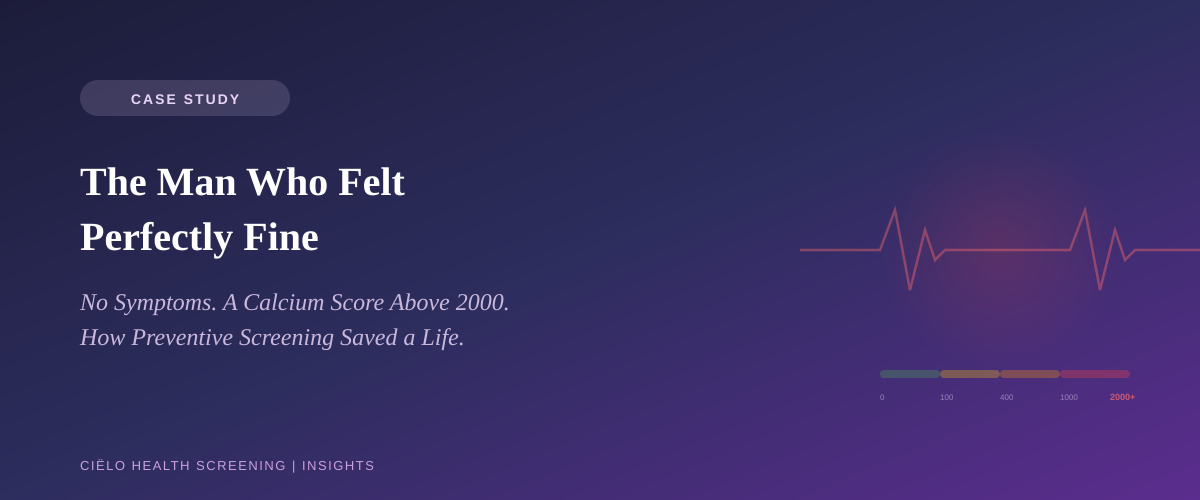
CASE STUDY | PATIENT NARRATIVE
The Man Who Felt Perfectly Fine
No Symptoms. A Calcium Score Above 2000. How Preventive Screening Saved a Life.
He did not walk in as a patient.
There was no chest pain. No shortness of breath. No fatigue that could not be explained by the ordinary demands of a busy life. By every external measure—his energy, his appearance, his daily capacity—he was well. He exercised occasionally. He worked long hours. He ate what most urban professionals eat. He had not seen a doctor in years because, as he put it, there was nothing to see a doctor about.
His visit was a concession to his family. His wife had read about preventive screening and insisted. He agreed, somewhat reluctantly, expecting the process to confirm what he already believed: that he was fine.
Within an hour, everything he believed about his health changed.
A Number That Demanded Attention
As part of the comprehensive screening, a CT coronary artery calcium score was performed. It is a quick, non-invasive scan—requiring no injection, no preparation, and taking less than ten minutes. It measures the amount of calcified plaque in the arteries that supply the heart, providing a direct structural assessment of coronary atherosclerosis.
His result was a calcium score above 2000.
Understanding the Calcium Score Scale
| Score Range | Clinical Significance |
| 0 | No detectable calcified plaque |
| 1 – 100 | Mild plaque burden; low-to-moderate risk |
| 100 – 400 | Moderate plaque burden; increased cardiovascular risk |
| 400 – 1000 | High plaque burden; significant coronary artery disease |
| 1000+ | Extensive coronary artery disease; urgent evaluation required |
A score above 2000 places an individual in the most extreme category of coronary calcification. It reflects years—likely decades—of progressive, silent plaque accumulation. The arteries, outwardly symptomless, were carrying a burden of atherosclerosis that, left undiscovered, could have resulted in a cardiac event at any time.
The Silent Architecture of Heart Disease
This case illustrates one of the most important and least understood truths about cardiovascular disease: it does not always announce itself. Plaque accumulates slowly. Arteries narrow over years. The body adapts—developing collateral circulation, adjusting its metabolic demands, masking the structural deterioration beneath a surface of normalcy.
For a significant number of individuals, the first clinical symptom of coronary artery disease is the event itself—a heart attack, an arrhythmia, or sudden cardiac death. There is no warning shot. There is only the event and its aftermath.
This is precisely why screening matters. The calcium score does not predict an event with the specificity of a weather forecast. What it does is reveal the structural substrate—the accumulated disease burden—that makes an event possible. It transforms abstract risk into visible, quantifiable reality.
What Happened Next
Because this finding was detected through screening rather than through an emergency, the response was measured, strategic, and potentially life-saving. Further cardiac evaluation was initiated immediately—including stress testing and, ultimately, coronary angiography. Medical management was commenced: statin therapy to stabilise plaque, antihypertensive adjustment, and antiplatelet medication where indicated.
Equally important were the lifestyle interventions that followed. Dietary patterns were restructured. A supervised exercise programme was introduced—carefully calibrated to his cardiac status. Stress management and sleep hygiene became part of the conversation, not as afterthoughts but as medical priorities.
He did not require emergency bypass surgery. He did not experience a heart attack. He walked out of the screening with a clear understanding of his risk, a comprehensive plan to address it, and the time—the critical, irreplaceable gift of time—to act before his body ran out of compensatory capacity.
Beyond a Single Number
At Ciëlo, a calcium score is never interpreted in isolation. It is read alongside the full panel of biomarkers that the screening generates: lipid profile, inflammatory markers such as high-sensitivity CRP, metabolic indicators, body composition data from DEXA, and liver assessment through ultrasound. This multi-layered approach ensures that findings are contextualised—that a high calcium score in the setting of controlled lipids and low inflammation tells a different management story than the same score in the setting of uncontrolled metabolic syndrome.
It is this synthesis that distinguishes screening from testing. A test generates a number. A screening programme generates understanding—a coherent narrative of where a person’s body stands and what it needs.
The Real Lesson
This man’s story is not exceptional. It is representative. In screening programmes around the world, significant incidental findings—cardiac, hepatic, pulmonary, oncological—are identified in individuals who present with no symptoms whatsoever. The body’s capacity for silent compensation is remarkable. But that capacity has limits.
Preventive screening exists to intervene before those limits are reached. It does not eliminate risk. It does not guarantee outcomes. What it does is open a window—a window of foresight that allows a person to act while the full range of options remains available.
Feeling fine is not the same as being risk-free. Sometimes, the most important diagnosis is the one you were never expecting.
Disclaimer: This content is for educational purposes only and does not constitute or replace medical consultation. Patient details have been anonymised.
Prevention operates in the absence of symptoms—which is precisely why it feels optional. But the most consequential health decisions are the ones made before urgency demands them.
About Ciëlo Health Screening Ciëlo Health Screening provides comprehensive preventive assessments including coronary calcium scoring as part of its 125+ biomarker, 100-minute screening programme. Every finding is cross-referenced across multiple modalities and interpreted by experienced clinicians before being communicated to the patient. |


.gif)