


MULTIMODAL INTELLIGENCE | EDITORIAL
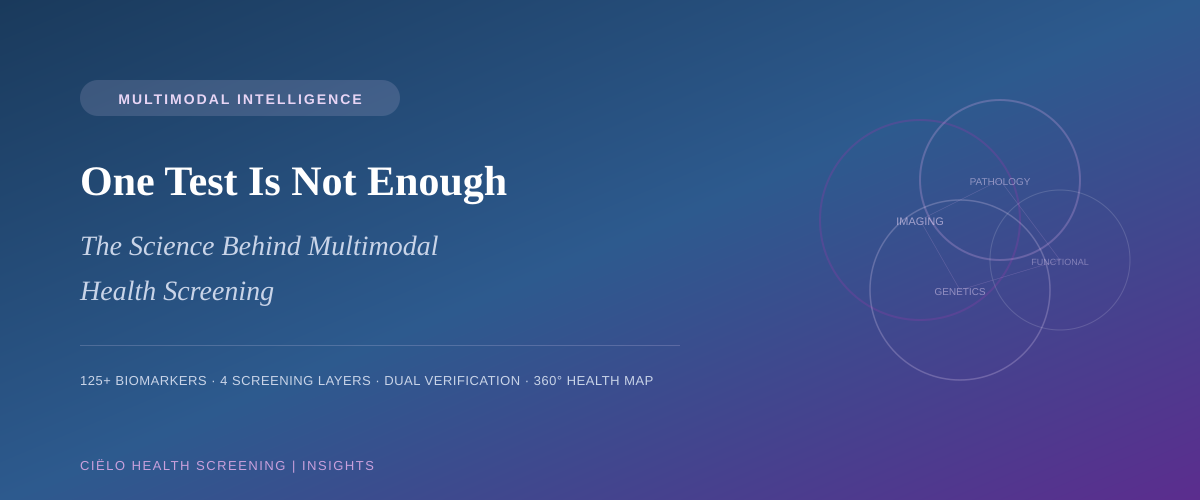
One Test Is Not Enough
The Science Behind Multimodal Health Screening
A blood test can tell you your cholesterol is elevated. It cannot tell you whether plaque has already begun to calcify in your coronary arteries. An ultrasound can reveal that your liver is fatty. It cannot tell you whether that fat has begun to trigger inflammation and fibrosis. A genetic panel can indicate predisposition to certain cancers. It cannot tell you whether those mutations have already begun to express.
Each of these tools, taken alone, offers a narrow view—a single dimension of a multidimensional reality. And in healthcare, acting on a single dimension is how critical patterns get missed. The person with normal cholesterol but a calcium score of 600. The individual with a clean ultrasound but deteriorating bone density. The young professional whose blood work looks reassuring but whose body composition reveals dangerous visceral fat accumulation.
This is why multimodal screening—the integration of imaging, pathology, functional testing, and genetics into a single, coordinated assessment—represents one of the most important advances in preventive medicine. Not because any single technology is new, but because their orchestration changes what we can see.
The Four Layers of Health Intelligence
Think of the body as a complex system—not unlike a large organisation. If you want to understand the true health of a company, you would not rely solely on its profit-and-loss statement. You would examine its balance sheet, cash flow, operational metrics, market position, and governance quality. Each lens reveals something the others cannot. The same logic applies to the human body.
Layer One: Biochemistry — The Blood Story
Comprehensive blood panels form the chemical foundation of any screening. They measure what is circulating—glucose, lipids, liver enzymes, kidney markers, thyroid function, inflammation indicators, tumour markers, vitamins, and minerals. A well-constructed panel of 60 to 80 blood parameters offers a snapshot of metabolic and organ function. It is indispensable. But it is a snapshot of chemistry, not of structure. A normal liver enzyme does not guarantee the absence of early fatty infiltration. A normal fasting glucose does not rule out insulin resistance
Layer Two: Imaging — The Structural Story
Advanced imaging—ultra-low dose computed tomography, DEXA scans, high-resolution ultrasound, digital mammography, and where indicated, whole-body MRI—reveals what blood cannot. It shows the physical reality inside the body: calcified plaque in arteries, fat deposits in the liver, bone density trajectories, early nodules in the lung, subtle masses in breast tissue. Modern ultra-low dose CT technology has made this possible with radiation exposure reduced by up to 97 per cent compared to standard protocols—making it safe enough for screening in asymptomatic individuals.
The combination of blood chemistry and structural imaging is already far more powerful than either alone. Elevated liver enzymes alongside an ultrasound showing hepatic steatosis tells a different story than either finding in isolation. A lipid panel showing borderline LDL alongside a calcium score of 300 demands a different response than the lipid panel alone.
Layer Three: Functional Testing — The Performance Story
Functional assessments—electrocardiography, echocardiography, pulmonary function testing, audiometry, ophthalmological screening—add a third dimension: how well the body’s systems are actually performing under their current conditions. An ECG can reveal rhythm abnormalities that blood work cannot detect. A pulmonary function test can identify early restrictive or obstructive patterns. An eye examination can detect diabetic retinopathy or glaucoma before the patient notices visual change.
Layer Four: Genetics — The Predisposition Story
Genetic screening adds the fourth and perhaps most forward-looking layer. It examines inherited risk—mutations in BRCA1 and BRCA2 that elevate breast and ovarian cancer risk, variants in LDLR and PCSK9 that predispose to familial hypercholesterolaemia, APOE genotyping that informs Alzheimer’s risk, and pharmacogenomic markers that determine how an individual metabolises specific medications. Genetics does not predict disease with certainty, but it illuminates predisposition—allowing surveillance and intervention to be tailored to the individual’s specific risk landscape.
The Power of Synthesis
The true value of multimodal screening emerges not in the individual findings but in their convergence. Consider a 42-year-old man who presents for a preventive screen. His blood work shows an HbA1c of 5.8 per cent—technically prediabetic but easily dismissed as borderline. His ultrasound reveals moderate hepatic steatosis. His DEXA scan shows visceral fat in the 85th percentile. His coronary calcium score is 120.
Each of these findings, reviewed in isolation by different specialists on different days, might generate a mild note of caution and little else. But viewed together, they describe a clear metabolic syndrome trajectory with concurrent cardiovascular risk accumulation. The story they tell collectively is urgent. The intervention they demand is immediate and coordinated: dietary overhaul, structured exercise, possibly pharmacological support, and close follow-up.
This is the difference between fragmented diagnostics and integrated health intelligence. The former generates data. The latter generates understanding.
The Principle of Dual Verification
In any screening programme serving asymptomatic populations, the stakes of false positives are high. A false alarm can generate anxiety, lead to unnecessary invasive procedures, and erode trust in the screening process itself. This is why the most rigorous screening models employ dual verification—using two or more independent modalities to confirm or contextualise a finding before it is flagged to the patient.
If a CT scan suggests a pulmonary nodule, that finding is cross-referenced with clinical history, blood-based tumour markers, and where necessary, follow-up imaging at defined intervals. If a blood panel suggests thyroid dysfunction, it is correlated with ultrasound findings. This layered verification reduces false positives, increases diagnostic confidence, and ensures that the person sitting across from the doctor receives not a collection of scattered alerts but a coherent, validated health narrative.
The 100-Minute Architecture
One of the practical barriers to comprehensive screening has always been time. When imaging, blood work, functional tests, and consultations are scattered across multiple facilities and multiple days, compliance drops sharply. People cancel follow-ups. Reports get lost. The holistic picture never forms.
The most effective screening models solve this by compressing the entire journey into a single, carefully sequenced visit. The patient arrives, undergoes vitals and baseline assessments, moves through imaging stations in a choreographed sequence that eliminates waiting, provides blood samples that are processed while imaging continues, and completes functional tests in the intervals between. By the time the patient sits down with a physician, the data has been aggregated, cross-referenced, and structured into a unified report.
This is not merely operational efficiency. It is clinical design. The seamlessness of the experience is itself a form of medical rigour—ensuring that the synthesis happens not days later in a fragmented review but in real time, with all data points available simultaneously.
From Data to Decision
The ultimate measure of any screening programme is not the sophistication of its technology or the breadth of its biomarker panel. It is what happens after the report is delivered. Does the person understand what the findings mean? Do they know what to do next? Do they feel empowered rather than alarmed?
This is where the science of screening meets the art of communication. Reports must be clinically accurate and simultaneously accessible to a layperson. Scoring systems—grading findings from normal to urgent—help translate complexity into clarity. Organ-by-organ breakdowns, longitudinal trend tracking, and clear next-step recommendations transform raw data into a roadmap that patients can act on.
The goal is not to overwhelm. It is to illuminate. A well-designed report should leave a patient not with a stack of numbers but with a narrative—a clear understanding of where they stand, what deserves attention, and what they can do about it. One test is never enough. But the right combination of tests, interpreted together and communicated with clarity, can change the trajectory of a life.
Health is a system, not a number. Understanding it requires looking through multiple lenses—because the patterns that matter most are the ones that only emerge when the whole picture comes together.
About Ciëlo Health Screening Ciëlo’s 125+ biomarker screening integrates four layers of health intelligence—blood chemistry, advanced imaging, functional assessment, and genetic profiling—into a single 100-minute journey. Every finding is cross-verified, every report is physician-interpreted, and every patient leaves with a clear, actionable health map. |


.gif)